Plant Response Diagnosis System for Hidden Stress Detection in Soilless Crops (PRDS)


Innovator:
Inv. Sepideh Abedi
Owner of the innovation:
Plant Response Diagnosis System for Hidden Stress Detection in Soilless Crops (PRDS)
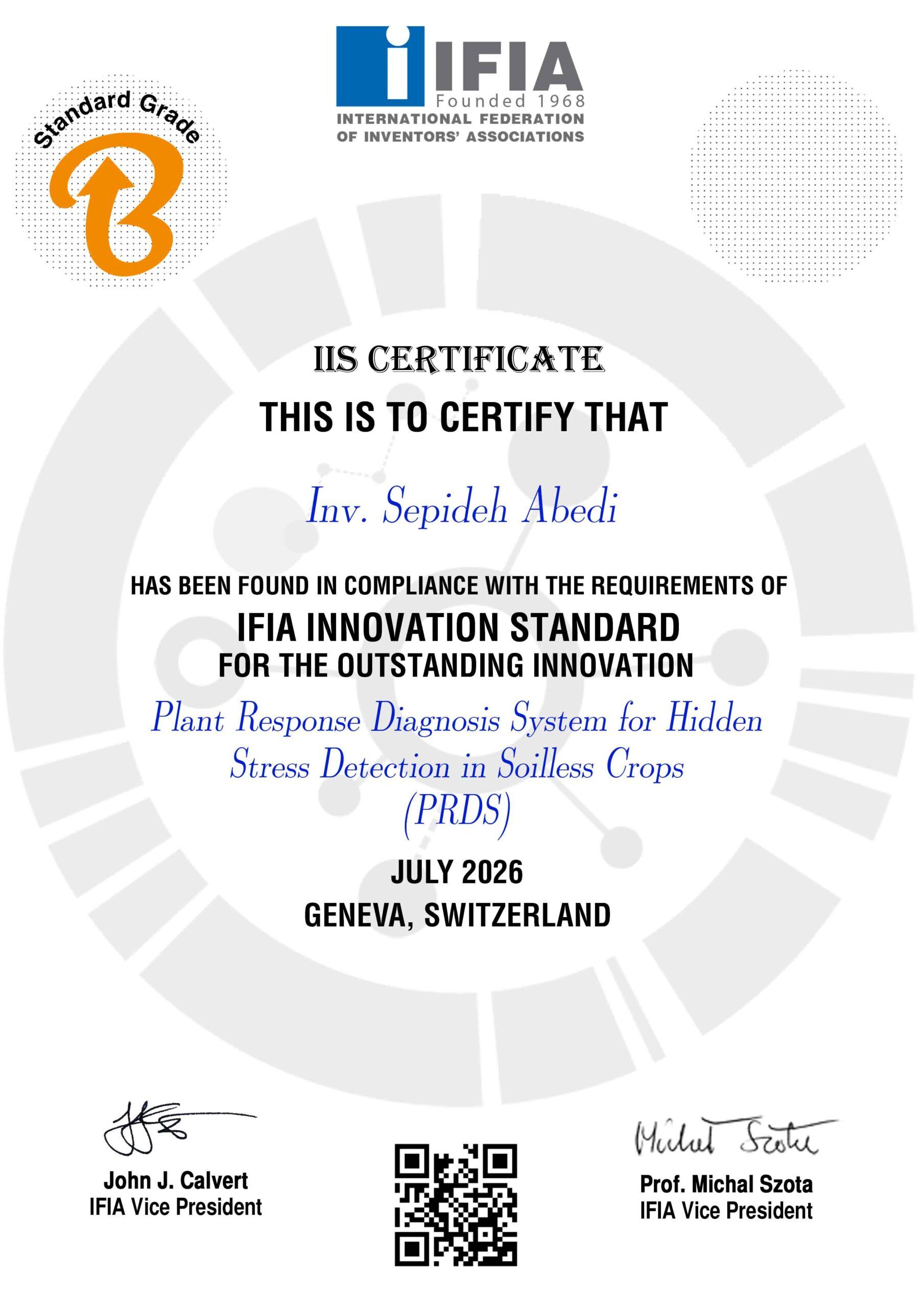
Acknowledgment: Congratulations on being one of the pioneer innovators who have obtained the IFIA Innovation Standard certificate (IIS).
Following your inquiry for an IIS certification, the jury board evaluated your application according to the criteria. And after the assessment and examinations, your innovation was granted with IFIA Innovation Standard Grade B.
IFIA hopes that by having this certification, you will take an essential step in the commercialization of your innovation. Also, by entering international markets, you can contribute to the realization of the global slogan: Generating wealth through innovative knowledge.
The Summary of Innovation:
The Plant Response Diagnosis System (PRDS) is an explainable decision-support system designed to detect hidden physiological stress in soilless greenhouse crops such as rockwool, coco coir, and hydroponic systems. In modern greenhouses, substrate and environmental sensors may show acceptable values, while the plant may still suffer from stress caused by high atmospheric demand, osmotic pressure, root-zone limitation, oxygen deficiency, unsuitable root temperature, or non-uniform irrigation. PRDS addresses this problem by analyzing substrate data, environmental data, and plant-response data in one integrated diagnostic framework. The system estimates the Expected Plant Response (EPR) based on current substrate and environmental conditions and compares it with the Actual Plant Response (APR) observed from the plant.
When a meaningful deviation is detected, the system calculates a Mismatch Index (MI), classifies the probable cause of stress, and provides a practical corrective recommendation.
Unlike conventional greenhouse monitoring systems that mainly display sensor values separately, PRDS evaluates whether the plant is responding as expected under the current growing conditions. This makes the system useful for early detection of hidden stress before severe visible symptoms appear.
Why is this innovation eligible to receive the IIS certification?
This innovation is eligible to receive the IFIA Innovation Standard (IIS) certification because it presents a new and practical approach to smart greenhouse diagnosis. The main innovation is not the use of a new sensor, but the creation of an explainable diagnostic process that compares the expected behavior of the plant with its actual physiological response.
Most existing greenhouse systems focus on monitoring substrate conditions, plant status, or environmental parameters separately. PRDS combines these three layers and transforms raw sensor data into meaningful diagnostic outputs. By detecting mismatches between expected and actual plant responses, the system can identify hidden stress conditions that may not be recognized through ordinary monitoring.
The innovation has strong practical value because it helps growers move from simple data observation to decision-making. It can support earlier stress detection, better irrigation and climate management, reduced crop loss, and more efficient use of water, nutrients, and energy. The system is also scalable and can be implemented with low-cost IoT hardware, web dashboards, and future greenhouse automation platforms. Its explainable structure makes it suitable for growers, researchers, and commercial greenhouse operators.
About Sepideh Abedi
Sepideh Abedi is an agricultural engineering and horticultural science specialist with professional experience in technical consulting for farmers and agricultural production systems. Her academic and professional background is closely related to plant physiology, horticulture, crop production, and greenhouse management. This background provides a strong foundation for developing an innovation focused on plant response, root-zone conditions, soilless cultivation, and smart agricultural decision-support.
Through the PRDS project, she has contributed to the development of an applied AgTech innovation that connects plant physiology with sensor-based greenhouse management. The project reflects her interest in practical agricultural problem-solving, modern greenhouse technologies, and the development of tools that can help growers make more accurate and timely decisions. PRDS also represents a bridge between traditional agricultural expertise and emerging technologies such as IoT, data-driven diagnosis, and explainable decision-support systems.