More Than 200 Institutions Have Registered to Join the Alliance for Science, Technology and Innovation
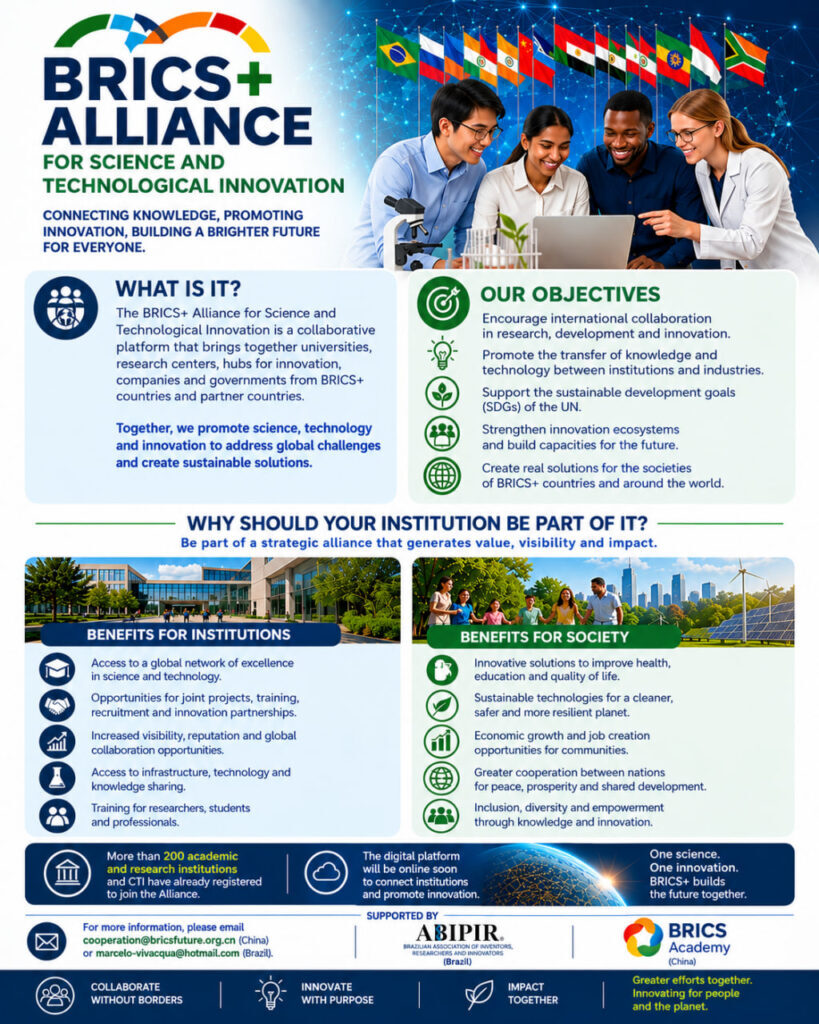
The IFIA-BRICS/BRICS+ Committee invites institutions connected with the International Federation of Inventors’ Associations (IFIA) to join the BRICS+ Alliance for Science, Technology and Innovation, an international cooperation initiative connecting universities, research centres, innovation hubs, companies, and public and private institutions.
Operating as one of the programmes within the Committee, the Alliance provides a collaborative platform for developing institutional partnerships, exchanging knowledge, and advancing joint initiatives in education, science, technology, and innovation. More than 200 academic, research, and science, technology and innovation institutions have already registered to join the Alliance.
International Leadership and Institutional Cooperation
The initiative is led by Mr. Alireza Rastegar, President of IFIA, and Mr. Liu Zhenying, President of the BRICS Academy of Skills Development and Technology Innovation (Xiamen), with the support of Professor Marcelo Vivacqua, PhD, Founder and President of ABIPIR — the Brazilian International Association of Inventors, Scientists and Innovative Entrepreneurs.
Their cooperation brings together institutional leadership and international innovation networks to create practical opportunities for universities, research organisations, inventors, and innovators. The initiative reflects a shared commitment to strengthening partnerships and connecting complementary expertise across borders.
An Expanding Network Across BRICS, BRICS+ and International Partners
Established within the framework of IFIA, the IFIA-BRICS/BRICS+ Committee develops programmes that strengthen international cooperation, expand opportunities for IFIA members, and connect innovation ecosystems across BRICS and BRICS+ countries and their international partners.
The Alliance extends this work by connecting institutions with complementary research capabilities, infrastructure, expertise, and development objectives. Its cooperation framework includes institutions from countries maintaining diplomatic relations with BRICS countries, supporting engagement beyond the BRICS membership itself.
Through these connections, the Alliance aims to help institutions identify common interests, establish partnerships, and translate shared priorities into collaborative projects and measurable results.
Opportunities for Participating Institutions
Participation in the Alliance offers institutions opportunities to strengthen their international presence and develop cooperation across several areas:
- International networking: Establish connections with universities, research centres, innovation hubs, enterprises, and public institutions in different countries.
- Joint research and development: Identify partners for scientific research, technological development, and multidisciplinary projects.
- Education and talent development: Explore academic cooperation, training, professional exchanges, and opportunities for researchers, students, and young innovators.
- Technology transfer and commercialisation: Exchange knowledge and technological solutions, support innovation commercialisation, and strengthen cooperation between academia and industry.
- International visibility: Present institutional achievements, research capabilities, innovative projects, and technologies to a wider international audience.
- Strategic partnerships: Develop relationships that support new initiatives, international projects, and long-term institutional cooperation.
- Sustainable development: Collaborate on solutions that contribute to the United Nations Sustainable Development Goals and address shared social, economic, and environmental challenges.
Participation provides a starting point for identifying common interests and exploring cooperation. The Alliance’s objective is to create the conditions for meaningful partnerships that benefit participating institutions and the communities they serve.
Part of IFIA’s Broader International Cooperation Strategy
The BRICS+ Alliance for Science, Technology and Innovation is one programme within the wider activities of the IFIA-BRICS/BRICS+ Committee. The Committee promotes cooperation in science, technology, innovation, education, intellectual property, standardisation, technology transfer, and skills development.
Through its programmes, the Committee seeks to connect IFIA’s global network with expertise and opportunities available through BRICS and BRICS+ cooperation. The Alliance complements this work by facilitating institutional relationships that can lead to joint research, educational initiatives, innovation projects, international exchanges, and solutions with practical applications.
For IFIA member associations and connected institutions, the initiative offers a means of engaging more actively in international cooperation and sharing knowledge, expertise, and innovation across borders.
Alliance Information and Participation
Institutions interested in joining the BRICS+ Alliance for Science, Technology and Innovation are invited to review the information document and its Frequently Asked Questions (FAQs) for details about the Alliance’s objectives, cooperation framework, and participation opportunities.
Applications to Join the IFIA-BRICS/BRICS+ Committee
Applications to join the IFIA-BRICS/BRICS+ Committee can be made by downloading the application form and following the instructions provided in the document.
Contact Information
For further information about the Alliance and opportunities for cooperation, please contact:
Email: cooperation@bricsfuture.org.cn
Additional contact: marcelo-vivacqua@hotmail.com
Turning International Cooperation into Practical Impact
The IFIA-BRICS/BRICS+ Committee encourages IFIA member associations and connected institutions to explore the Alliance and become active participants in its expanding international network.
By connecting institutions, sharing expertise, and encouraging cooperation across education, science, technology, and innovation, the Alliance aims to turn shared ambitions into practical achievements and lasting institutional partnerships.