Shadow Faucet


Innovators:
Maryam Rastegari, Alireza Rastegari, Amin Khalili, Mohammadhossein Sharifnia, Tahereh Nikoudel
Owners of the innovation:
Shadow Faucet: Systems and Methods for Designing and Fabricating an Improved Multi-Component Washing and Fire-Fighting Device
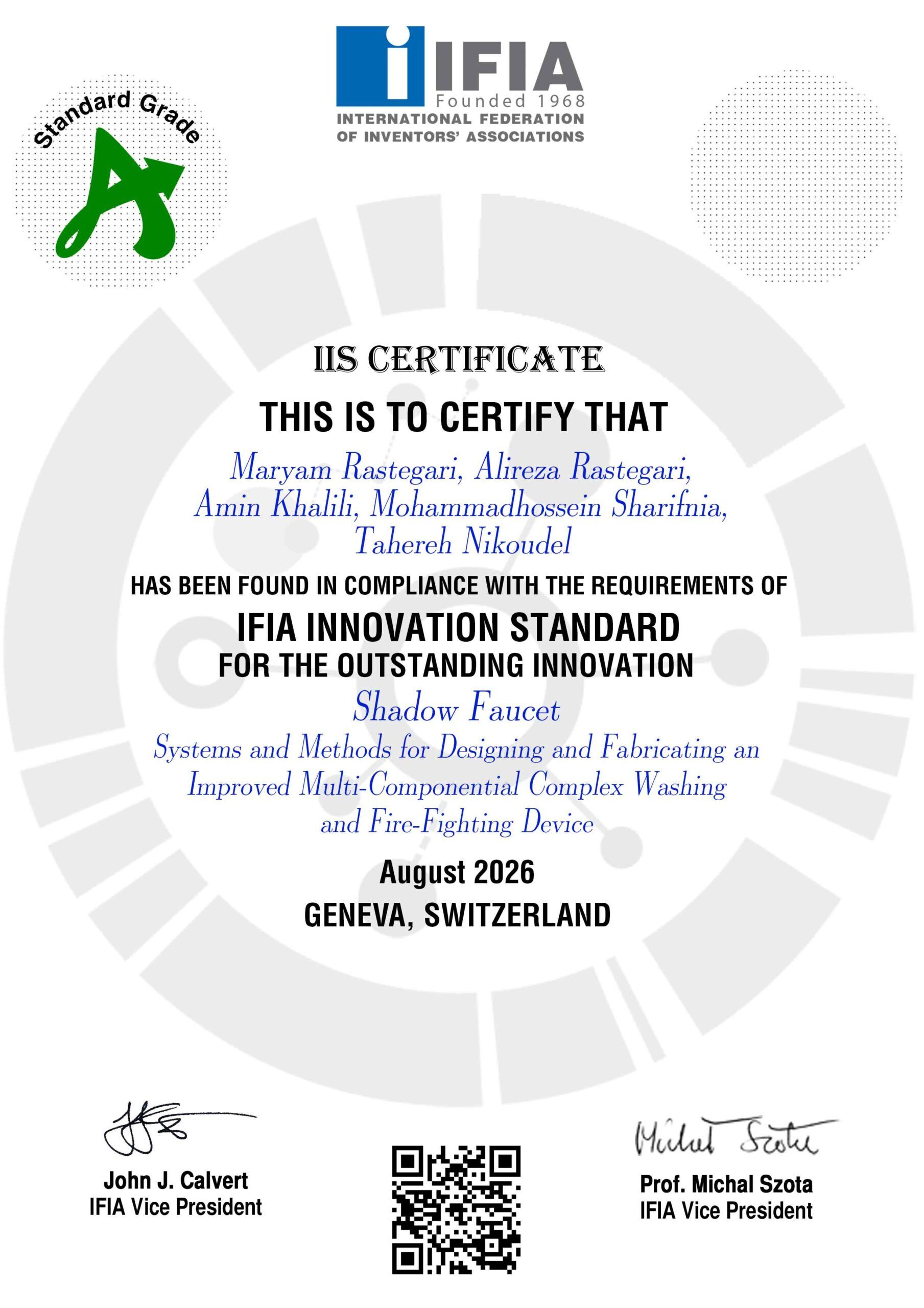
Acknowledgment: Congratulations on being one of the pioneer innovators who have obtained the IFIA Innovation Standard certificate (IIS).
Following your inquiry for an IIS certification, the jury board evaluated your application according to the criteria. And after the assessment and examinations, your innovation was granted with IFIA Innovation Standard Grade A.
IFIA hopes that by having this certification, you will take an essential step in the commercialization of your innovation. Also, by entering international markets, you can contribute to the realization of the global slogan: Generating wealth through innovative knowledge.
The Summary of Innovation:
A Smarter Way to Clean, Dry, and Protect Surfaces
Cleaning systems have changed very little over the past decades. Most still depend on large volumes of water, long washing cycles, and separate drying processes. In homes, public facilities, factories, hospitals, and industrial environments, this approach leads to unnecessary water consumption, higher energy use, longer operating times, and gradual damage to surfaces exposed to moisture.
Our invention was developed from a simple question: Can water be used more intelligently rather than simply used in greater quantities?
The answer became a multi-component washing and fire-fighting system that combines fluid engineering, controlled heating, pressure management, and rapid drying in a single integrated device. Instead of relying on excessive water flow, the system improves the effectiveness of the cleaning fluid itself and then removes residual moisture quickly and efficiently.
Why Conventional Systems Fall Short
Whether a system uses liquid water or steam, the same practical problems are often encountered:
- High water consumption during cleaning operations.
- Long washing and drying times.
- Energy losses caused by heating large volumes of water.
- Residual moisture left on surfaces after cleaning.
- Corrosion, oxidation, and gradual surface degradation.
- Higher maintenance and operating costs.
These challenges become especially important in places where cleaning is performed repeatedly every day or where water and energy efficiency are critical.
How the Technology Works
The system uses a coordinated set of mechanical, thermal, and fluid-control components to manage the behavior of water and other cleaning fluids during the washing process.
By controlling intermolecular interaction, temperature, and pressure conditions, the device increases cleaning efficiency while reducing the amount of fluid required. Immediately after washing, the same system accelerates evaporation and drying, minimizing the time that water remains on the surface.
In practical use, the device performs cleaning, sanitizing, and drying as one continuous process rather than three separate operations.
This approach not only saves resources but also helps protect metals, ceramics, stone, composite materials, and other sensitive surfaces from long-term moisture-related damage.
Key Benefits
- Substantially lower water consumption.
- Faster cleaning and drying cycles.
- Reduced energy demand.
- Less corrosion and oxidation on treated surfaces.
- Lower operational and maintenance costs.
- Improved hygiene and cleaning performance.
- Longer service life of equipment and surfaces.
- Environmentally responsible operation.
Applications
The technology is designed to be scalable and adaptable across a wide range of environments:
- Industrial manufacturing facilities.
- Hospitals and healthcare centers.
- Hotels, restaurants, and public buildings.
- Food-processing and sanitation facilities.
- Transportation and municipal cleaning systems.
- Fire-fighting support and emergency response equipment.
- Smart building and infrastructure projects.
Environmental Contribution
Water scarcity is no longer a regional issue; it is a global reality. The purpose of this invention is not simply to make cleaning faster, but to make it more responsible. By reducing water consumption and shortening drying time, the system decreases both resource use and energy demand while maintaining effective cleaning performance.
For countries and industries seeking practical solutions for sustainability, this technology offers a realistic step toward more efficient use of water without compromising operational requirements.
Recognition and Intellectual Property
The invention has been officially registered through the international intellectual property system and has received recognition at major international invention exhibitions, including awards from Germany, Switzerland, and the United States. It has also been presented at leading technology and sustainability events in the Middle East and Europe.
Closing Statement
This project began with concern for a resource that every society depends on: water. Through years of practical experience, engineering development, and international collaboration, we created a system that cleans more efficiently, dries more quickly, and uses less water. Our goal is straightforward to provide a technology that makes every day cleaning safer, more economical, and more sustainable for the generations ahead.